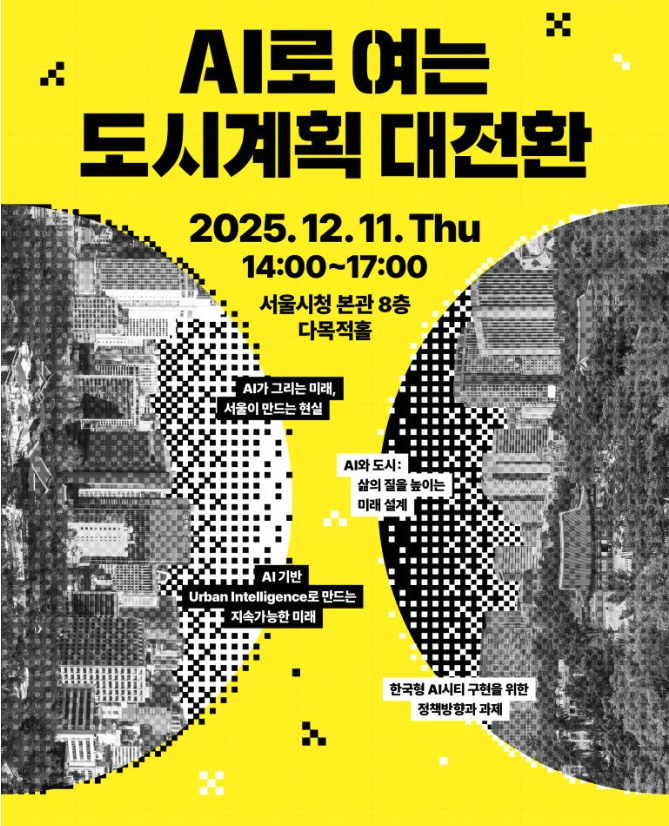
🏙️ Conference Report: AI-Driven Urban Planning Transformation
2025 Urban Spatial Policy International Conference
| Category | Details |
|---|---|
| Date | December 11, 2025 (Thu) |
| Location | Seoul City Hall, Multipurpose Hall (8F) |
| Theme | Future Cities Evolving with Data-Driven Urban Intelligence |
| Key Speakers | Seoul Metropolitan Gov, ARUP, Foster + Partners, KRIHS |
| Author | Kade |
💡 Executive Summary
The conference explored the paradigm shift in urban planning driven by Artificial Intelligence. It moved beyond simple "Smart Cities" to discuss "Urban Intelligence," focusing on how AI can act as a tool for sustainability, social usefulness, and proactive urban management.
While the official sessions covered macro-level policies and broad visions, this report reconstructs the insights by cross-referencing the presentations with technical methodologies (e.g., Space Syntax) to provide a concrete "Urban AI Anatomy."
🗣️ Session Highlights
1. Keynote: AI Vision for Seoul
- Speaker: Seoul Metropolitan Government
- Concept: "Future mapped by AI, Reality made by Seoul."
- Key Takeaway: Introduction of the Digital Twin Seoul and data-driven administrative systems to solve complex urban issues (traffic, safety, environment).
2. Philosophy: Social Usefulness (ARUP)
- Speaker: Peter Vang Christensen (ARUP)
- Theme: AI for Climate and Sustainability.
- Key Concepts:
- Passive AI: AI shouldn't be intrusive; it should quietly optimize the environment.
- Social Usefulness: Technology must serve the quality of life and happiness of citizens, not just efficiency.
3. Methodology: Urban AI Anatomy (Foster + Partners)
- Speaker: Laura Narvaez Zertuche (Foster + Partners)
- Theme: Urban Intelligence.
- Key Concepts:
- The City as a Neural Network: Viewing the city as a living, thinking organism.
- Space Syntax: utilizing graph theory and AI to analyze spatial configurations and predicting human movement/behavior patterns.
4. Ecosystem: K-AI City Policy (KRIHS)
- Speaker: Korea Research Institute for Human Settlements
- Theme: Policy Directions for a Korean AI City.
- Key Concepts:
- Non-Predatory Model: Inspired by Montreal's Mila, advocating for an ecosystem where big tech, startups, and academia coexist without monopoly.
- Governance: The need for a "K-AI City Special Act" and regulatory sandboxes (similar to the EU TEF).
🧠 Key Insights: 5 Pillars of Urban AI
Reconstructed insights analyzing the convergence of philosophy, technology, and policy.
| Dimension | Case / Organization | Core Insight | Keywords |
|---|---|---|---|
| Philosophy | ARUP (Denmark) | "AI is a tool for quality of life and happiness." | Social Usefulness, Passive AI |
| Methodology | Foster + Partners (UK) | "The city is an intelligent entity with a neural network." | Urban AI Anatomy, Space Syntax |
| Implementation | Beijing & Toyota | "Large-scale verification via infrastructure & Living Labs." | Vehicle-Road-Cloud, Woven City |
| Ecosystem | Mila (Montreal) | "A knowledge hub where talent and companies coexist." | Non-Predatory Model |
| Trust | EU TEF | "Safe verification and regulatory sandboxes." | Regulation, Testing Facility |
📝 Critical Review & Future Vision
Critique: Beyond Macro Discourse
The conference largely remained at a macroscopic and abstract level regarding "Future Cities." However, simply applying AI to cities does not create intelligence.
To gain deeper actionable insights, I re-analyzed the presentations through the lens of Urban AI Anatomy. The true value lies not just in "collecting data" but in understanding the spatial logic (Space Syntax) that dictates how that data flows and how people interact with the built environment.
Vision: K-AI City
My vision for a "K-AI City" combines the technical rigor of an agent-based system with human-centric values:
- Self-Acting Agent City: A city that doesn't just display data but autonomously diagnoses and responds to urban problems (e.g., energy, traffic).
- Human-Centric "Warm Tech": Technology that remains invisible ("Passive") but actively supports the social well-being of its inhabitants.
"The ultimate goal of Urban AI is not to build a smarter machine, but to build a more humane city."